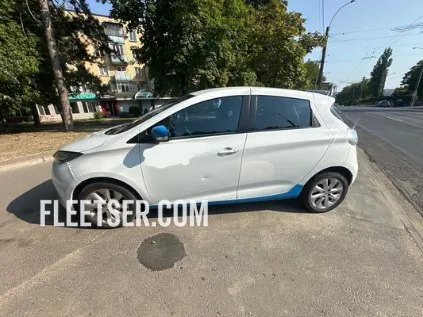
Nissan Leaf - Manufacturer specification
SourceFrom the manufacturer’s published sheet for this model. Individual units in a fleet can differ.
Power and speed depend on the market a vehicle was built for. EU pedal-assist bikes are capped at 250 W and 25 km/h under EN 15194, and scooter limits are set nationally - 20 km/h in Germany, 25 in most of the rest. On shared fleets these are normally firmware settings rather than hardware, so ask us what a fleet is currently configured to and what it can be set to for your market.
Variants of this model differ materially. 'Nissan Leaf' spans two generations and four battery sizes, and the badge is identical. FIRST GENERATION (ZE0/AZE0, 2010-2017): 24 kWh, 80 kW / 107 hp motor, 187 lb-ft; from MY2016 Nissan offered a 30 kWh pack on SV/SL while the base S kept 24 kWh — Nissan's own 2016 US press kit gives 84 miles EPA for the 24 kWh and 107 miles EPA for the 30 kWh, both with 192 cells. SECOND GENERATION (ZE1, 2018 onward): 40 kWh, 110 kW, 320 Nm, 350 V, 270 km WLTP, 1,594 kg, 145 km/h — the figures recorded above; and e+ 62 kWh, 160 kW, 340 Nm, 350 V, 385 km WLTP, 1,736 kg, 158 km/h, which is 142 kg heavier and needs 11h30 rather than 7h30 on a 6.6 kW AC supply. So a 2013 24 kWh car and a 2019 62 kWh car are both 'Nissan Leaf' with roughly a 2.6x difference in usable energy and a completely different charging profile. Two further warnings. Battery health, not badge, sets the value: a 2013 24 kWh car will typically have lost a large fraction of its original capacity, and the gen-1 packs in hot climates degraded severely — always read the state-of-health bars or a CAN-bus SOH report per car, never assume nameplate kWh. And gen-1 cars from 2011-2012 in some markets shipped with a 3.3 kW on-board AC charger rather than 6.6 kW, doubling overnight turnaround time. The 62 kWh e+ is also physically slightly taller in some markets. Price and plan charging per VIN, not per model.
Battery and range
- Nominal voltage
- 350 V
- Pack capacity
- 40 kWh (laminated lithium ion)
- Claimed range
- 270 km indicative driving range using the WLTP test procedure for the European spec model — manufacturer claim
- Charge time
- AC 6.6 kW (32 A Mode-3) 7h30; DC 50 kW CHAdeMO 60 min; DC 100 kW CHAdeMO 60 min (20-80%)
- Battery
- Fixed
Motor and performance
- Rated power
- 110 kW maximum power; 320 Nm maximum torque
- Top speed
- 145 km/h
- Max rider load
- 437 kg payload (GVM 1,988 kg) — Australian homologation
Physical and build
- Net weight
- 1,594 kg (kerb)
- Dimensions
- 4,490 × 1,788 × 1,540 mm; wheelbase 2,700 mm
- Wheel size
- 215/50 R17
- Brakes
- Ventilated disc front and rear