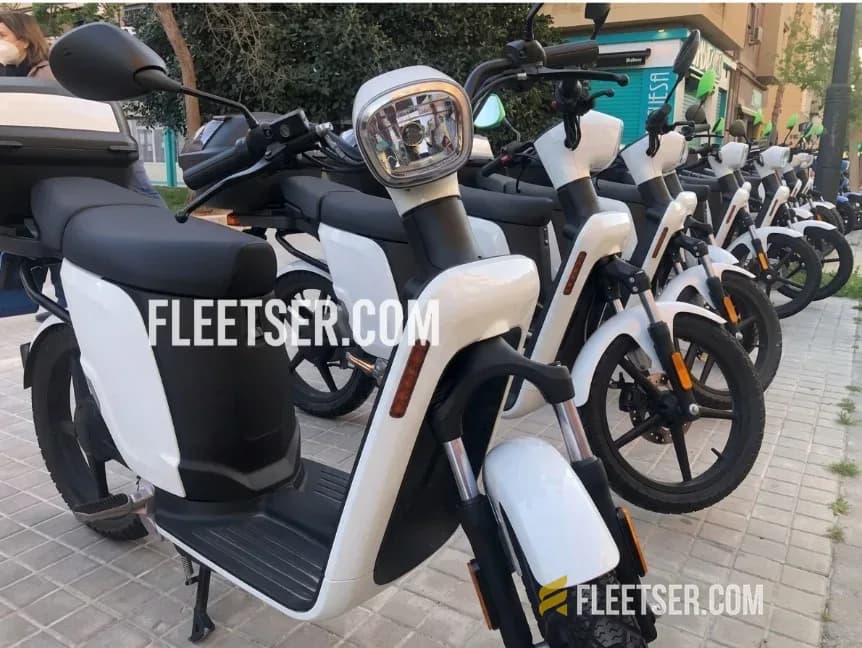
Was Askoll zu diesem Modell veröffentlicht, und was wir davon haben.
Aus dem veröffentlichten Datenblatt des Herstellers für dieses Modell. Einzelne Fahrzeuge einer Flotte können davon abweichen.
Power and speed depend on the market a vehicle was built for. EU pedal-assist bikes are capped at 250 W and 25 km/h under EN 15194, and scooter limits are set nationally - 20 km/h in Germany, 25 in most of the rest. On shared fleets these are normally firmware settings rather than hardware, so ask us what a fleet is currently configured to and what it can be set to for your market.
Was Askoll nicht veröffentlicht, bleibt hier leer, statt mit einer Zahl aus anderer Quelle gefüllt zu werden. Two Askoll-authored sources were combined and each figure is attributable. The sharing-specific figures — 2,800 Wh across 2 battery packs, 'Easy to swap' with 'Fast and safe swapping connectors', 'Autonomy up to 75km', 'Power 2.200W', 'Tourque 130 Nm' and 'Type L1' homologation — come from Askoll EVA's own corporate 'Sharing Solutions' presentation, which explicitly names an 'eS2 Sharing' model; note that document is mirrored on a distributor server (abaq-alsedra.com/wp-content/uploads/2019/12/062019_ENG-Askoll_EVA-Sharing.pdf) because Askoll's own /site/en/sharing-* pages now return 404 after a site restructure. Voltage, charge time, speed, weight, tyres, brakes and dimensions come from Askoll's live shop and model pages for the eS2 EVOlution My2022, which shares the same 2,800 Wh two-pack architecture as the sharing version. Range is a manufacturer claim, and the sharing figure (75 km) is deliberately quoted in preference to the consumer figure (81 km) because fleet duty cycles are harsher. Deliberately omitted: motPeak and motGradeability (never published); phyIp (never published); motMaxLoad — Askoll publishes only a 245 kg 'maximum allowable weight', which is gross vehicle weight, not rider payload, and putting it in a max-load field would badly mislead a buyer; phyFrame (never published).